
A Complete Taekwondo Stretching Routine for High Kicks
Master the specific hip mobility, active hamstring length, and standing split progressions required to deliver clean, head-height kicks in Taekwondo.

Delivering high kicks in Taekwondo requires far more than casual flexibility. Kicking at head height demands an open pelvic girdle, supple hamstrings under tension, and active end-range control on a stable supporting leg. If you rely solely on passive floor splits, you will notice your kicks stall well below eye level when you stand up.
Effective taekwondo stretching targets functional range: rotating the hip capsule, decompressing the posterior chain while balancing on one foot, and teaching the adductors to release without collapsing your posture. By conditioning your body to control split angles upright, your chamber becomes smoother and your extension reaches full height with zero strain.
To kick high in Taekwondo, you must train dynamic hip mobility and standing balance alongside hamstring flexibility. This routine starts with hip rotations and single-leg hamstring crouches, then advances into active standing split variations that develop the upright end-range control required for head-height strikes. Practice the mobility drills before kicking and hold the standing splits after your session.
Passive Flexibility vs. Dynamic Chamber Range
Sitting in a static split on a dojang mat creates length across relaxed tissues, but standing for a head kick forces one leg to stabilize your entire body weight while the other contracts forcefully into an overhead extension. Stretching for taekwondo must train the joint to rotate and stabilize simultaneously. Without hip mobility and active core engagement, the pelvis tilts backward, the lumbar spine rounds, and the kicking knee cannot rise above chest level.
A complete taekwondo mobility routine integrates three specific phases: hip joint lubrication, dynamic hamstring lengthening through crouches and folds, and upright split conditioning. Practicing these movements sequentially prepares the hip joint for high axe, roundhouse, and side kicks.
Phase 1: Pelvic and Hip Mobility Warm-Up
Before placing deep tension on the hamstrings or groin, you must lubricate the acetabulofemoral (hip) joints. Hip circles rotate the femur head through its full circumference, loosening tight gluteal and adductor attachments while teaching you to maintain an upright, neutral spine.
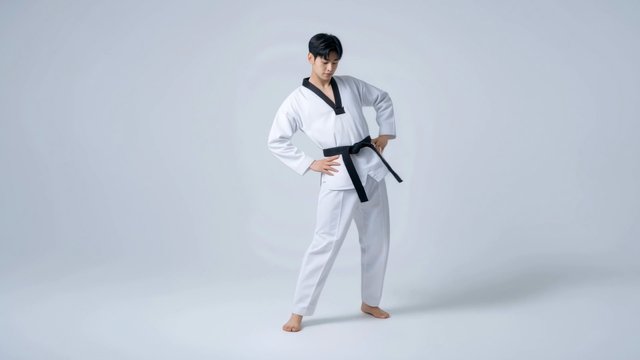
Follow your circles with rotational hip twists. In Taekwondo, pivoting on the ball of the foot transfers rotational torque into linear strike speed. Standing hip twists disassociate pelvic turning from the upper torso, warming up internal and external hip rotators without sacrificing balance.
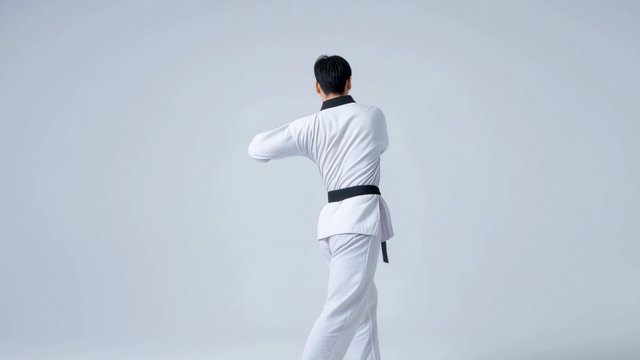
Phase 2: Loaded Hamstring Length and Hip Decompression
A tight hamstring shortens the trajectory of front kicks and prevents the chambered leg from locking out overhead. Rather than using purely passive forward bends, the hamstring crouch strengthens the supporting quadriceps while deeply stretching the extended hamstring.
Lower into a crouch on your right side while keeping your left leg straight out in front. Reach toward the left foot, engaging your core muscles to maintain balance rather than collapsing onto your calf.
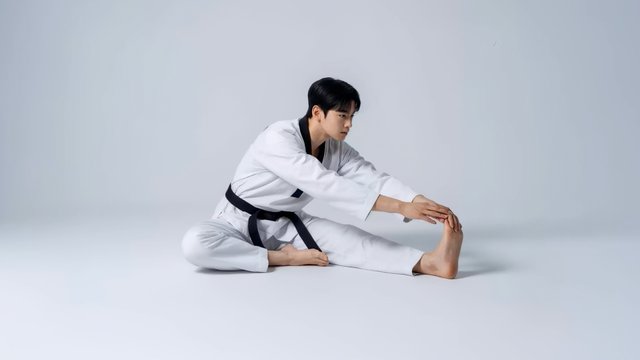
Transition smoothly over to the opposite side. Control your descent slowly to build eccentric strength in the supporting hip and ankle, then extend the right hamstring without letting your supporting heel peel off the floor abruptly.
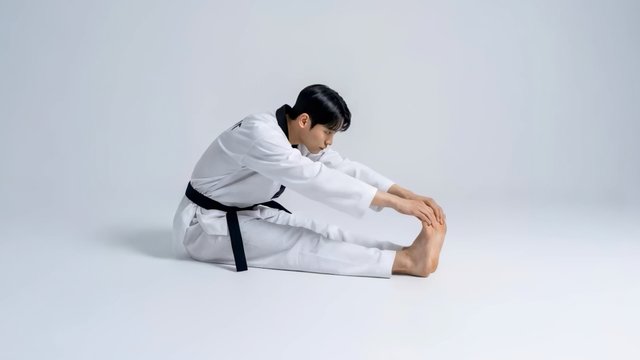
Once both legs have experienced unilateral loaded stretching, transition to a symmetrical forward fold. The double-leg hamstring stretch decompresses the lower back, lengthens both hamstrings simultaneously, and reinforces the straight-knee lockout required for snapping techniques.
Phase 3: Standing Splits for Vertical Kicking Range
The standing split is the core exercise of taekwondo flexibility. Unlike floor splits, it forces the supporting foot to grip the floor, stabilizes the base knee, and trains active hip extension against gravity. Start with the neutral standing split, lifting one leg as high as possible while keeping your standing leg firm and your hips square.
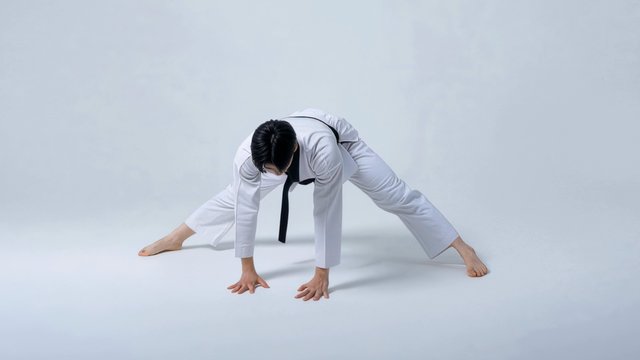
To increase thoracic alignment and deepen the stretch on the kicking side, reach with both hands toward the lifted left leg. Keep your standing knee slightly soft rather than hyperextended, relaxing your upper torso to pull your chin closer toward the shin.
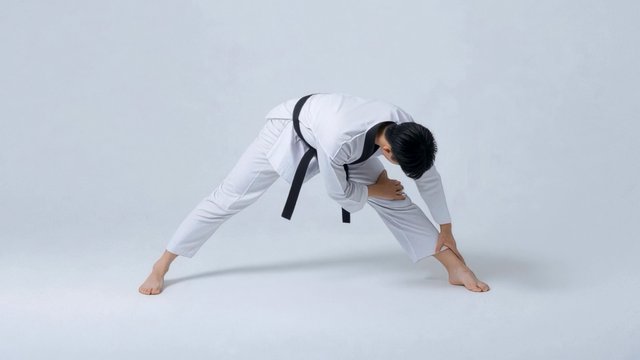
Repeat this extension on the right side. Focus on controlled execution rather than violent swinging. Lifting smoothly ensures that your deep hip flexors and glutes manage the movement without triggering a protective muscle contraction.
Next, incorporate contralateral coordination with alternating arm-to-leg reaches. This rhythmically transfers load between sides, closely mimicking the alternating footwork and kicking combinations used in sparring.
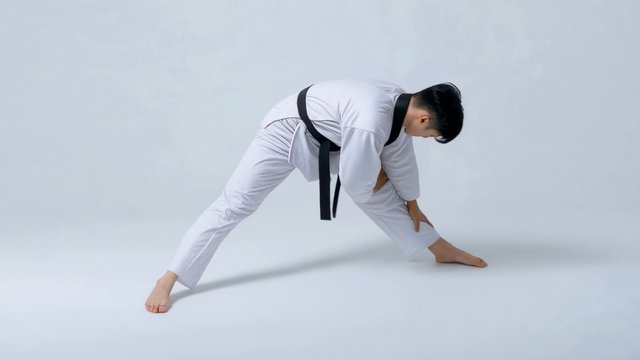
Phase 4: Deep Grounded Splits for High Angle Clearance
For practitioners working toward vertical axe kicks or high roundhouse strikes, grounding the hands provides the balance required to push past standard end ranges. Place your palms flat on the mat while driving the raised leg toward the ceiling.
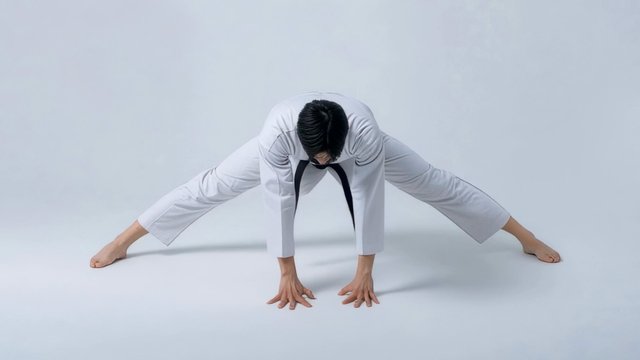
When your flexibility progresses, lowering your elbows to the floor increases the acute angle between your torso and your supporting leg. This deep hinge develops the extreme pelvic tilt necessary to release the hip socket during maximum-height kicks.
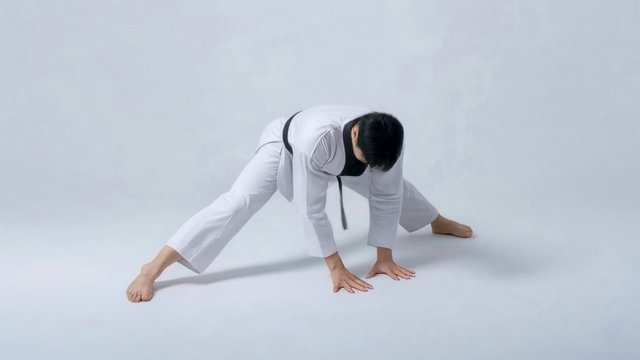
Finally, practice the standing split with your toes pointing upward toward the ceiling. In Taekwondo, orienting the toes and knee upward replicates the extension path of high front kicks and axe kicks, aligning the patella correctly and avoiding joint shear.
How to Structure Your Weekly Training
To gain permanent range without overtaxing your joints, vary your intensity across the week. Dynamic hip mobilizers like hip circles and alternating standing splits work best as pre-workout preparation before kicking practice. Deep static holds and grounded elbow splits belong at the end of class or in standalone recovery sessions.
- Pre-training (5 minutes): Perform hip circles and standing hip twists with a smooth, continuous rhythm to warm up synovial fluid.
- Post-kicking cooldown (10 minutes): Work through hamstring crouches and standing split arms to floor holds for 20 to 30 seconds per side.
- Rest day recovery: Follow structured, low-intensity sessions like the Recovery program to flush muscular tension without impact.
Never lock or hyperextend the knee of your standing leg during vertical split drills. A micro-bend engages the quadriceps and hamstring co-contractions, shielding the posterior capsule and keeping your balance centered over the midfoot.
Common mistakes
Why it holds you back: This jams the knee joint capsule, shuts off stabilizing musculature, and shifts dangerous tension into the knee ligaments. Fix: Maintain an active micro-bend in the standing knee, distributing your weight evenly across the entire foot.
Why it holds you back: Curving the thoracic spine gives an illusion of reaching lower while taking critical tension off the hamstring belly. Fix: Keep the chest proud and hinge directly from the pelvic crease before reaching down toward your ankle.
Why it holds you back: Opening the pelvis avoids the target stretch in the hamstring and creates asymmetrical torque through the lumbar spine. Fix: Keep both hip points squared toward the floor or target wall, raising the leg only as high as square hips allow.
Why it holds you back: An unstable base reduces stretch depth on the extended leg and strains the Achilles tendon. Fix: Firmly plant the supporting foot and lower your hips under control using active core tension.
High Kick Flexibility & Split Sequence
Perform after a light general warm-up or immediately following kicking practice. Hold durations are suggested targets.
- Hip Circles 45 seconds (suggested) — Keep circles smooth and continuous in both directions with an upright, relaxed torso.
- Standing Hip Twist 45 seconds (suggested) — Twist your hips smoothly while keeping your core braced and shoulders centered.
- Hamstring Crouch 30 seconds (suggested) — Descend with control on your right leg and keep your extended left leg straight.
- Hamstring Crouch 30 seconds (suggested) — Plant the supporting foot firmly and reach toward the right foot without rounding your neck.
- Hamstring Both Legs 30 seconds (suggested) — Hinge deeply at the waist and breathe out as your torso relaxes toward your thighs.
- Standing Split Alternate Arms to Leg 45 seconds (suggested) — Lift each leg rhythmically with control, reaching your opposite hand without jerking.
- Standing Split Arms to Floor 30 seconds per side (suggested) — Ground your palms for balance, keep the base knee soft, and drive the back heel upward.
- Standing Split Toes Pointing Up 30 seconds per side (suggested) — Align your toes straight toward the ceiling to open the hip in true high-kick extension.
Durations marked “suggested” are editorial recommendations, not data from the app.
How often should I do this taekwondo stretching routine?
Perform dynamic mobility movements like hip circles and twists before every kicking session. Deeper standing split progressions should be trained 3 to 4 times per week after training when muscles are warm.
Why can I do a floor split but my kicks are still low?
Floor splits demonstrate passive range under body weight. High kicks require active mobility, hip flexor strength, and stabilizing balance on the standing foot to hold that range upright.
Should I stretch before or after kicking practice?
Dynamic stretching (smooth rotations and controlled leg raises) should be done before kicking to prepare joints. Deep, prolonged holds belong after training when tissues are warm and relaxed.
Was this helpful?
Thanks for your feedback!
Comments
No comments yet — be the first.