
How to Master the Taekwondo Tornado Kick at Home
Master the spectacular Taekwondo tornado kick with our detailed home training guide. Learn the step-by-step technique, common mistakes to avoid, and progress safely.

The taekwondo tornado kick is one of the most dynamic, visually striking, and effective jumping kicks in martial arts. Known for its explosive rotation and sudden change of angles, this kick is a staple in both sparring competitions and technical demonstrations. While it looks incredibly complex, it is built on fundamental movements that can be broken down and practiced safely in a home environment.
To perform this kick successfully, you do not need a massive gym or specialized gear. By mastering the individual phases of the rotation—the pivot, the chamber, the jump, and the release—you can build the necessary coordination and muscle memory right in your living room.
To master the taekwondo tornado kick at home, you must break the technique down into three distinct phases: the pivot, the knee chamber, and the jump-kick. Start by pivoting on your front foot to turn your back to your target, drive your non-kicking knee upward to generate spinning momentum, and then jump to execute a roundhouse kick with the opposite leg. Practicing these phases slowly and prioritizing spotting your target will build the balance and coordination needed for a fluid, powerful execution.
Quick Answer: How to Perform the Tornado Kick
To execute a taekwondo tornado kick, start in your fighting stance, pivot on your front foot to turn your back to the target, and lift your back knee to generate spinning momentum. As you spin, jump off your supporting foot, switch your legs in mid-air, and execute a roundhouse kick with the opposite leg before landing smoothly. To master this technique at home, practice the rotation slowly without jumping, focus on spotting your target, and gradually add the jump-kick phase as your balance improves.
Understanding the Tornado Kick Technique
The tornado kick technique relies on rotational mechanics rather than raw physical strength. Many beginners try to force the kick by jumping as high as possible, which often results in a loss of balance and a weak strike. Instead, the power of the kick comes from the momentum generated by your hips, shoulders, and the initial knee lift.
Your core acts as the engine for this movement. Engaging your abdominal and hip muscles allows you to control the spin, preventing your body from over-rotating or drifting off-line. Keeping your arms close to your chest during the spin also reduces your moment of inertia, making your rotation faster and more compact.
Step-by-Step Guide: How to Do a Tornado Kick
Here is the step-by-step breakdown to practice the left-sided execution of this jump kick. Focus on executing each step deliberately before trying to speed up the motion.
Executing the Left Tornado Kick
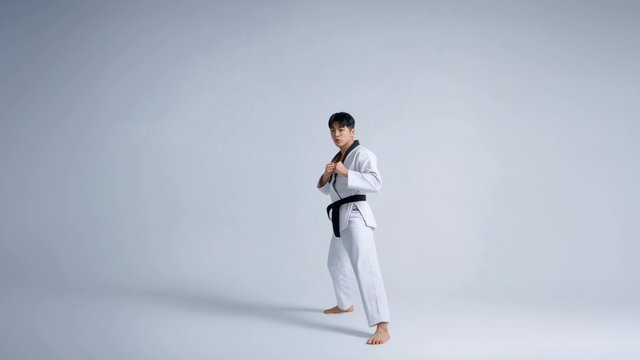
- The Setup and Pivot Start in your guard stance. Pivot on your right foot and turn your body to the left, rotating your shoulders first so you can spot your target over your shoulder.
- The Chamber and Spin Lift your left knee high toward your chest while spinning. This knee drive is crucial as it generates the upward momentum needed to lift you off the ground.
- The Jump and Strike Jump off your right foot, switching your legs in mid-air. Extend your left leg in a fluid, circular motion to strike the target with a roundhouse kick.
- The Retraction Retract your kicking leg quickly after making contact. Snapping the leg back prevents opponents from catching it and helps you maintain your balance.
- The Landing Land smoothly on your feet, absorbing the impact with bent knees, and immediately return to a stable guard position.
How to Progress Safely at Home
If you are new to jumping kicks, jumping directly into a full spin can be difficult. You can build up to the full movement by using progressive training structures. A great way to start is by practicing your basic kicks with the support of a chair to build hip strength and balance, a method featured in the Kicks Mastery program.
Once your basic balance is secure, focus on fluid transitions. The Combo Master program is excellent for learning how to link your footwork with dynamic combinations, ensuring your body is comfortable shifting weight between kicks. Finally, to refine the speed, height, and air control required for advanced jumping kicks, the Black Belt program provides the technical depth needed to polish your flow and precision.
Frequently Asked Questions
Common mistakes
Why it holds you back: This opens up your defense, slows down your rotation by widening your center of gravity, and ruins your landing posture. Fix: Keep your hands tucked close to your chest or chin throughout the entire rotation to stay compact and protected.
Why it holds you back: This puts immense rotational stress on your knee joint and kills your spinning momentum. Fix: Ensure your supporting foot has fully pivoted backward before your feet leave the ground.
Why it holds you back: This leads to dizziness, poor accuracy, and a complete loss of balance upon landing. Fix: Practice spotting: keep your eyes on the target, turn your head first during the spin, and lock your gaze back onto the target before releasing the kick.
Home Tornado Kick Progression Routine
Perform this routine on a non-slip surface. Focus on control and smooth transitions rather than raw speed.
- Tornado Kick Practice only the pivot and the left knee lift without jumping. Focus on keeping your core engaged and spotting your target quickly.
- Tornado Kick Perform the pivot, lift your left knee, and jump to switch feet without releasing the final kick. Focus on landing softly on your feet.
- Tornado Kick Combine all phases into a fluid motion. Stay relaxed, engage your hips, and snap the kick back quickly before landing.
Durations marked “suggested” are editorial recommendations, not data from the app.
Was this helpful?
Thanks for your feedback!
Comments
No comments yet — be the first.