How to Get the Full Split for Taekwondo Kicks
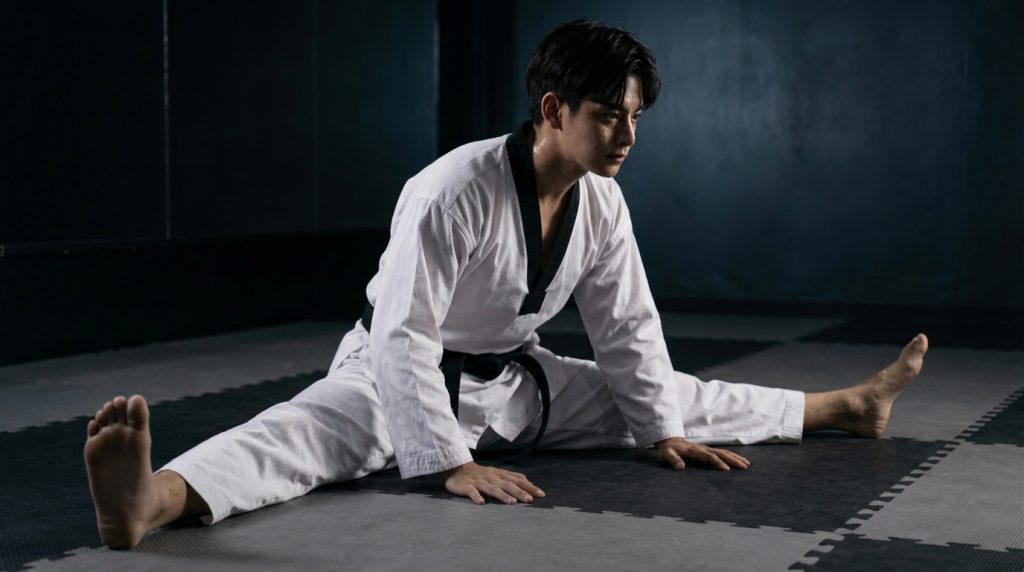
Why the Full Split Matters for Taekwondo Kicks
In Taekwondo, high kicks require a large range of motion in the hips and legs.
The full split is often seen as the ultimate flexibility goal because it represents maximum hip and adductor flexibility.
However, the goal is not just to touch the floor.
The real objective is to use full split flexibility to kick higher, with more control and less tension.
Do You Really Need the Full Split to Kick High?
No, the full split is not mandatory to kick high in Taekwondo.
Many athletes can kick head height without a perfect split.
That said, training toward the full split offers major benefits:
- Easier access to high kick range
- Less resistance in the hips
- Better control during kicks
- Lower risk of muscle strain
Think of the full split as a tool, not a requirement.
What Limits Your Full Split the Most?
Most people think the hamstrings are the main problem.
In reality, the biggest limitations usually are:
- Tight adductors
- Limited hip mobility
- Poor active flexibility
- Lack of relaxation in stretched positions
Flexibility is not just about muscle length. It is also about control and nervous system adaptation.
The 3 Rules to Train the Full Split Safely
Train the Full Split Gradually
Forcing the split is the fastest way to get injured.
Progress should be slow, controlled, and pain-free.
You should feel:
- Stretch
- Mild discomfort
You should never feel sharp pain.
Warm Up Before Any Split Work
Never train the full split cold.
Before stretching:
- Light cardio
- Hip circles
- Dynamic leg swings
A warm body adapts much faster and safer.
Combine Passive and Active Flexibility
Passive stretching helps you go lower.
Active flexibility helps you use that range in kicks.
Both are essential for Taekwondo.
Key Exercises to Achieve the Full Split
Dynamic Adductor Stretch
Slow side leg swings or controlled side raises help prepare the inner thighs for deeper positions.
Middle Split Progression
Lower gradually into a middle split position using your hands for support.
Hold for short periods while breathing calmly.
Active Leg Lifts
From a standing position, lift the leg sideways and hold briefly.
This builds strength inside the split range.
Hip Mobility Drills
Internal and external hip rotation drills reduce joint restrictions that block split progress.
How Often Should You Train the Full Split?
For most Taekwondo practitioners:
- 4 to 5 sessions per week
- 10 to 15 minutes per session
Short and frequent sessions work better than long, aggressive stretching.
How Long Does It Take to Get the Full Split?
This depends on:
- Your starting flexibility
- Age
- Training consistency
Most practitioners see:
- Clear progress in 3–4 weeks
- Deep split positions in 2–4 months
Some may need longer, and that is completely normal.
Common Mistakes When Training the Full Split
Stretching Only Passively
Passive stretching alone does not transfer well to kicks.
Training Only on Rest Days
Split training works best after regular training when muscles are warm.
Chasing the Floor Too Fast
Flexibility improves when the body feels safe. Forcing slows progress.
How the Full Split Improves Taekwondo Kicks
When trained correctly, the full split helps you:
- Kick higher with less effort
- Move more freely in side kicks and roundhouse kicks
- Maintain balance at high range
- Reduce muscle tension during fast kicks
The result is cleaner, smoother, and more controlled kicks.
Final Advice on Training the Full Split for Taekwondo
The full split is not a competition.
It is a long-term flexibility goal that supports better Taekwondo performance.
Train it:
- Progressively
- Consistently
- Without pain
Over time, your kicks will feel lighter, higher, and more natural.
Want a Structured Full Split Program for Taekwondo?
If you want to work toward the full split with a program designed specifically for Taekwondo kicks, try the Taekwondo Kicks Training app.
You get:
- Kick-specific flexibility routines
- Progressive split training
- Short and effective sessions
7-day free trial available.
Download on the App Store or Google Play.